
Driving in Turkey: Traffic Rules for Foreign Drivers
Speed limits, alcohol limits, motorway tolls, parking rules and emergency numbers for foreign drivers taking the wheel in Turkey.
Driving in Turkey is close to most of Europe, with a few differences worth knowing before you set off. The same rules apply in a rental car, which you can hire in Antalya without a deposit.
The basics
Traffic drives on the right, the steering wheel is on the left. At junctions you give way to traffic coming from your right.
Seat belts are compulsory in front and rear seats. Children under 150 cm need an age-appropriate seat; you can rent a child seat with the car.
The alcohol limit is 0.50 per mille for drivers of private cars and 0.20 per mille for drivers of other vehicles, such as commercial ones. In practice the safest rule is not to drive after a glass of wine at all, since checks are frequent in summer.
Daytime headlights are not compulsory. They are required in tunnels and whenever visibility drops.
Holding a phone while driving is banned; hands-free is allowed.
Speed limits
- Urban roads: 50 km/h
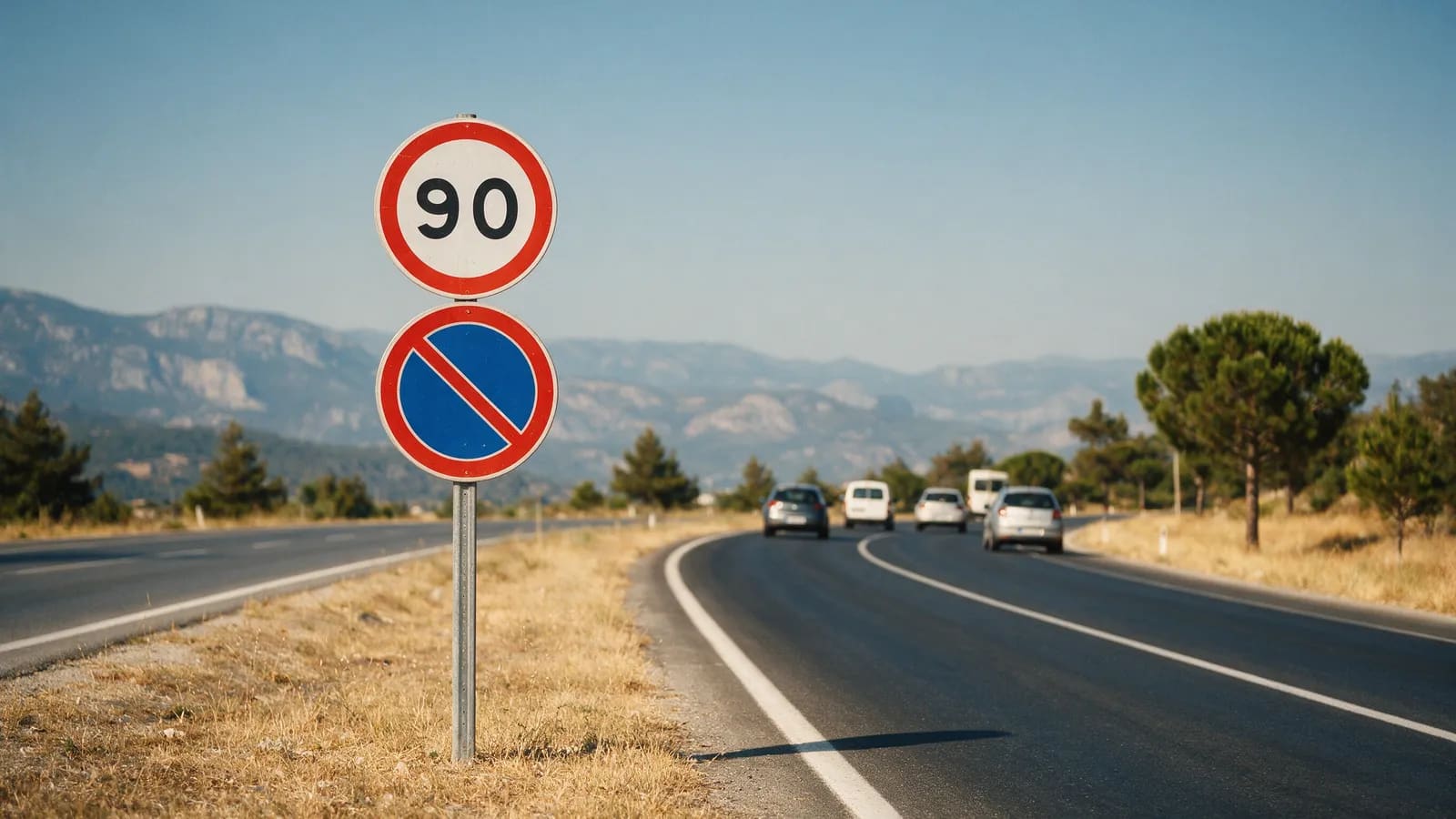
- Intercity dual-direction roads: 90 km/h
- Divided roads with a central reservation: 110 km/h
- Motorways: 130 km/h, on some sections 140 km/h
Where a sign says otherwise, the sign wins. Speed cameras are common at town entrances and along the D400 coast road. Most camera points are signposted in advance, though not all. On a rental car, fines are issued to the plate and passed on to you.
Motorway tolls
Turkish motorways have no cash booths; tolls run through an electronic system called HGS. Rental cars come with the HGS sticker already fitted, so you simply slow down and drive through. How you pay for those tolls depends on your booking: if you add the Motorway toll charge (HGS) extra, your motorway and bridge tolls during the rental are covered by that one fee and you can use toll motorways and bridges as often as you like; if you do not, you pay for the tolls you have run up when you return the car. Only Istanbul's toll motorways are not covered by the Motorway toll charge (HGS) extra.
Almost every road around Antalya is toll-free, including the whole D400 coast road: the Antalya-Alanya and Antalya-Kaş stretches cost you nothing. HGS only comes into play if you drive beyond the region, to provinces with motorways or toll bridges. Even so, confirm the HGS sticker is on the windscreen when you collect the car.
Parking
Blue-marked bays are paid, usually to a municipal attendant on the street. Red-and-white kerb markings and a yellow line mean no parking.
Parking is genuinely difficult in Kaleiçi, along Konyaaltı beach and in the centre during summer. Car parks are cheap and plentiful; driving straight into one usually costs less time than circling for a street space.
Badly parked cars do get towed. If your car has vanished, call 153 for the municipal helpline.
Local driving habits
Indicator use can be inconsistent, so do not assume a car changing lanes will signal. Motorcycles filter between lanes, so check mirrors often. On rural roads expect tractors and livestock, especially around sunset. In Antalya's city traffic an automatic such as the Fiat Egea Automatic leaves you free to concentrate on all of this.
Accidents and emergencies
Call 112 for everything: ambulance, fire, police and gendarmerie share the number.
After an accident, photograph the scene before moving the vehicles. For damage-only accidents, drivers who agree on what happened can complete the accident report form themselves. In a rental car, call the rental company however minor the damage; undocumented damage falls outside insurance cover.
The vehicle documents (registration, insurance) are in the glovebox. At a roadside check you will be asked for your licence, passport and the registration.
Looking for a car in Antalya?
No prepayment, no deposit, free airport delivery. Choose your dates and see the price right away.